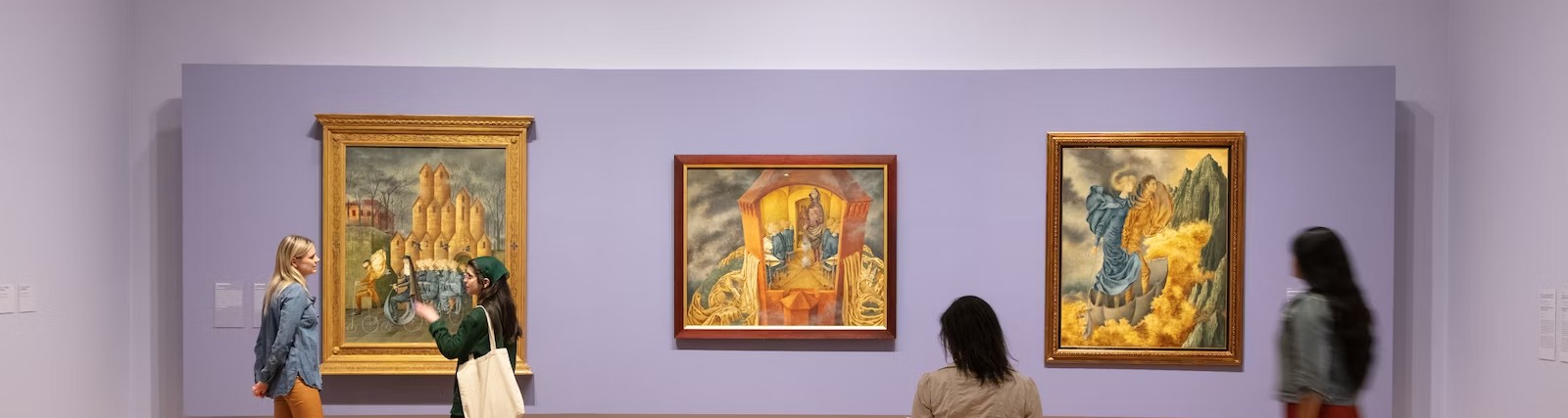
Remedios Varo and Salvador Dalí were both Spanish-born painters linked to Surrealism, yet their careers and imagery diverged sharply. This page sketches the shared ground and the differences, with Varo’s path drawn from Britannica, NMWA, MoMA, and the Art Institute.
Shared ground
Both trained in Madrid’s academic art world—Varo at the Real Academia de Bellas Artes de San Fernando, graduating in 1930 (Britannica)—and both intersected with Surrealism in the 1930s. Dalí became an early, highly public Surrealist star across Europe and the United States. Varo’s mature public success arrived later, largely from Mexico City in the 1950s (Britannica; NMWA). Both appear in histories of Surrealism; both used dream logic and meticulous craft, though to different public effects.
Geography of mature work
Dalí’s career remained tied to Europe, with long U.S. sojourns and a cultivated international celebrity. Varo fled wartime Europe in 1941 and emigrated permanently to Mexico City (Art Institute; Britannica). MoMA notes that most of her more than 500 works were produced in Mexico. Any comparison that treats both artists as if they shared one lifelong Paris studio misunderstands that split.
Public persona versus local renown
Dalí managed fame as part of the work’s theater. Varo, after 1956, drew crowds and waiting lists in Mexico City (Britannica; NMWA) but, Britannica notes, remained less widely known internationally than many male Surrealist contemporaries for decades. NMWA’s 2000 retrospective and Chicago’s 2023 show are milestones in correcting that imbalance—not proof that the two careers were ever symmetrical.
Imagery: tendencies, not checklists
Museum writing on Varo emphasizes alchemical laboratories, androgynous seekers, medievalizing architecture, music that moves matter, and optical instruments that create life (Art Institute dualities essay; Britannica). Dalí is widely associated in survey histories with melting forms, explicit dream shock, and Catholic and Freudian motifs. Those are tendencies discussed in art history—not rules that every canvas obeys. Palettes vary by work: Varo’s NMWA Call, for example, shows fiery orange-gold against muted grounds.
Women in the picture
The old page argued that Varo depicted women as powerful and mystical while Dalí objectified women. Feminist readings of both artists are more complex than that binary. NMWA notes Varo’s protagonists often carry her features yet remain androgynous or not-quite-human alter-egos rather than direct self-portraits. Surrealism’s wider gender politics—including Breton’s circle—are discussed in scholarship; this short guide does not settle them with a slogan. It does record that curators now foreground women Surrealists such as Varo as central, not decorative, contributors (Britannica legacy paragraph; Art Institute’s note that Science Fictions was its first solo show of a woman Surrealist painter).
Technique as a useful contrast
Both could be obsessive craftsmen. Varo’s documented toolkit—cartoons, scratched gesso, planned decalcomania, soufflage, mother-of-pearl inlay (MoMA; Art Institute)—rewards close looking at surface. Dalí’s academic illusionism is famous on its own terms. Comparing toolkits is safer than ranking genius.
Training parallels and divergences
Varo’s San Fernando graduation in 1930 (Britannica) places her in the same academic city culture that shaped other Spanish moderns. Dalí’s earlier Madrid training and earlier entry into Surrealist celebrity are often taught in survey courses; Varo’s path ran through Logicophobista Barcelona, Péret, wartime detention, and Mexican maturity. Comparing “Spanish Surrealists” without that geography flattens both careers.
Surrealism as shared language, not shared career plan
Both used dream logic and precise making. Varo’s documented Mexico toolkit—cartoons, decalcomania, inlay—has museum footnotes (MoMA; Art Institute). Dalí’s illusionism and public provocations have an enormous separate literature. A useful classroom move is to ask what each artist does with control and chance.
Teaching tip
Pair MoMA’s Juggler label with a Dalí museum object page, and ask students to list materials and procedures before discussing biography—craft first, myth second.
Mexico changes the comparison
Once Varo’s decisive pictures are understood as Mexico City works of 1955–1963 (Art Institute), comparing her only to Paris-era Dalí becomes a category error. Better comparisons ask how each artist handled fame, exile or homecoming, Catholic visual residue, and the female figure—using museum objects as evidence. NMWA’s note that Varo’s later work creates an alternate vision of Surrealism is a curatorial claim about her path, not a jab engineered for rivalry clickbait.
What a careful short guide can still say
They shared Spanish origins and Surrealist vocabulary. They diverged in geography, celebrity strategy, and the museum stories now told about women’s place in the movement. Varo’s documented materials and Mexican institutional home (MAM holdings; Chicago partnership) give teachers concrete anchors. Those anchors are enough for a short comparison.
Dates at a glance
Varo’s outline here runs 1908–1963: San Fernando 1930, Péret marriage 1937, Mexico late 1941, solo breakthrough 1956, death 1963 (Britannica, NMWA, MoMA, Art Institute). For a full Dalí biography, use a museum or encyclopedia entry dedicated to him.
For Varo alone, continue to biography, major works, and techniques.
Sources
- Encyclopaedia Britannica, Remedios Varo
- National Museum of Women in the Arts, Remedios Varo
- NMWA, La llamada (The Call)
- NMWA, The Magic of Remedios Varo (2000)
- Art Institute of Chicago, Remedios Varo: Science Fictions
- Art Institute of Chicago, The Dueling Dualities of Remedios Varo
- Art Institute publication, Remedios Varo: Science Fictions catalogue
- MoMA, Remedios Varo artist page
- MoMA, The Juggler (The Magician), 1956