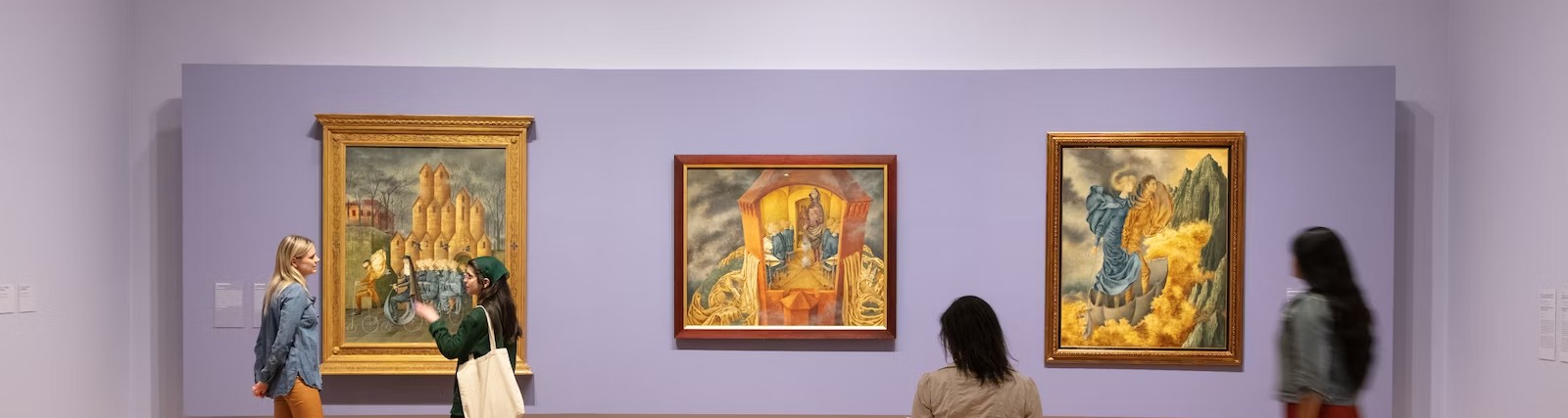
Mexico City, not Paris, is where Remedios Varo produced the paintings for which she is best known. Late 1941 arrival, commercial livelihood, friendship with Leonora Carrington, support from Walter Gruen, and the 1950s breakthrough are documented by Britannica, NMWA, MoMA, and the Art Institute of Chicago.
Arrival in late 1941
Britannica places Varo and Benjamin Péret in Mexico City from late 1941, fleeing Nazi-occupied France. The Art Institute’s Science Fictions page likewise says she fled Europe in 1941 because of World War II and emigrated permanently to Mexico City. NMWA’s profile matches that late-1941 timing after her early-1940 arrest in France and flight from Paris.
In Mexico City, Britannica says, they connected with locals such as writer Octavio Paz and with other exiled artists and writers, among them Wolfgang Paalen, Gordon Onslow Ford, and Leonora Carrington, who became Varo’s closest friend. Art Institute text describes a community of Mexican and European artists drawing inspiration from Mexico’s culture and geography.
Making a living before the mature oils
Britannica lists her first pursuits in Mexico City as commercial art, interior and costume design, and restoration of pre-Columbian pottery. NMWA notes that in the late 1940s, as she supported herself through commercial illustration, she began to develop her mature personal style.
Britannica states she began to devote her time entirely to painting only in 1953, by which time she had separated from Péret and was romantically involved with Austrian businessman Walter Gruen, who supported her painting activity. Those sentences from two museums describe a transition, not a contradiction: commercial work funded the late 1940s; Gruen’s support and full-time painting define the early 1950s onward.
Breakthrough: 1955–1956 and after
Britannica dates her first solo exhibition in Mexico City to 1956, with crowds and waiting lists for commissions. NMWA’s exhibition page for The Magic of Remedios Varo likewise says that from her first solo exhibition in Mexico in 1956 she was an instant celebrity, with crowds lining up and long waiting lists. She continued to exhibit thereafter and created the bulk of her work in the last ten years of her life (Britannica).
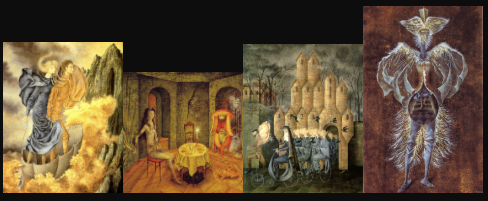
The Art Institute’s 2023 show focused on paintings from 1955 until her death in 1963—more than twenty paintings plus archival cartoons, notebooks, sketches, studies, ephemera, and personal possessions, organized with Museo de Arte Moderno in Mexico City. That institutional framing treats 1955–1963 as the decisive mature chapter.
MoMA’s artist summary states that by her death she had created over 500 works, most produced in Mexico. MoMA also holds the 1956 painting The Juggler (The Magician), a landmark of that decade’s craft (oil and inlaid mother-of-pearl on board).
What the Mexico paintings explore
Art Institute curators describe her practice of juxtaposing Surrealist chance-based techniques with imagery from chivalric romance, ecology, geographic exploration, feminist critique, mysticism, psychology, and tarot. Britannica emphasizes dreamlike atmospheres, alchemical activity, and medievalizing architecture. NMWA stresses science, magic, and women’s experience in richly detailed Surrealist works. Together those descriptions define the Mexico years.
Death in 1963
She died of a heart attack on 8 October 1963 in Mexico City (Britannica; NMWA). NMWA notes the death occurred as she was reaching new renown. Britannica and NMWA state heart attack and year.
Collections and memory in Mexico
An INBAL press notice on Museo de Arte Moderno describes a major Varo group of works entering the museum through Walter Gruen and heirs (comodato of paintings around 2000, later additions, and a 2018 archive donation including preparatory drawings). Exact room hangings change; check MAM for what is on view. Art Institute labels confirm works such as Creación de las aves (1957) and Ciencia inútil, o El alquimista (1955) as MAM holdings.
From commercial boards to personal myth
Commercial illustration, costume and interior design, and pottery restoration (Britannica) kept her working with craft disciplines—design deadlines, materials, clients—while Surrealist imagination continued off the clock. NMWA’s late-1940s note that mature style began during commercial illustration years is important: the famous oils did not appear from nowhere in 1955; they condensed habits formed under economic pressure. Gruen’s support from the early 1950s (Britannica: full-time painting from 1953) removed some of that pressure and coincides with the cluster of works Art Institute curators treat as her lasting contribution.
1955–1963 as a bounded chapter
Chicago’s exhibition subtitle Science Fictions names tensions Varo staged between disciplines as she searched for hidden orders and unseen truths (museum text). Bounding the show at 1955–1963 matches Britannica’s remark that the bulk of her work came in the last ten years of her life. MoMA’s count of over 500 works, most Mexican, includes earlier pieces, but public fame rests on this late chapter—alchemists, flutists, star catchers, jugglers, callers on quests.
Friends on the ground
Carrington’s friendship is the personal bond most clearly named by Britannica and NMWA. Horna’s 1963 portrait, credited on NMWA’s profile, freezes the studio at the end of the story. Other names Britannica lists—Paalen, Onslow Ford, Paz—map a bilingual intellectual city.
See also major works, Carrington and Horna, and exhibitions and museums.
Sources
- Encyclopaedia Britannica, Remedios Varo
- National Museum of Women in the Arts, Remedios Varo
- NMWA, The Magic of Remedios Varo (2000)
- Art Institute of Chicago, Remedios Varo: Science Fictions
- MoMA, Remedios Varo artist page
- MoMA, The Juggler (The Magician), 1956
- INBAL press note on Museo de Arte Moderno Varo holdings
- Art Institute of Chicago, The Dueling Dualities of Remedios Varo
- NMWA, La llamada (The Call)