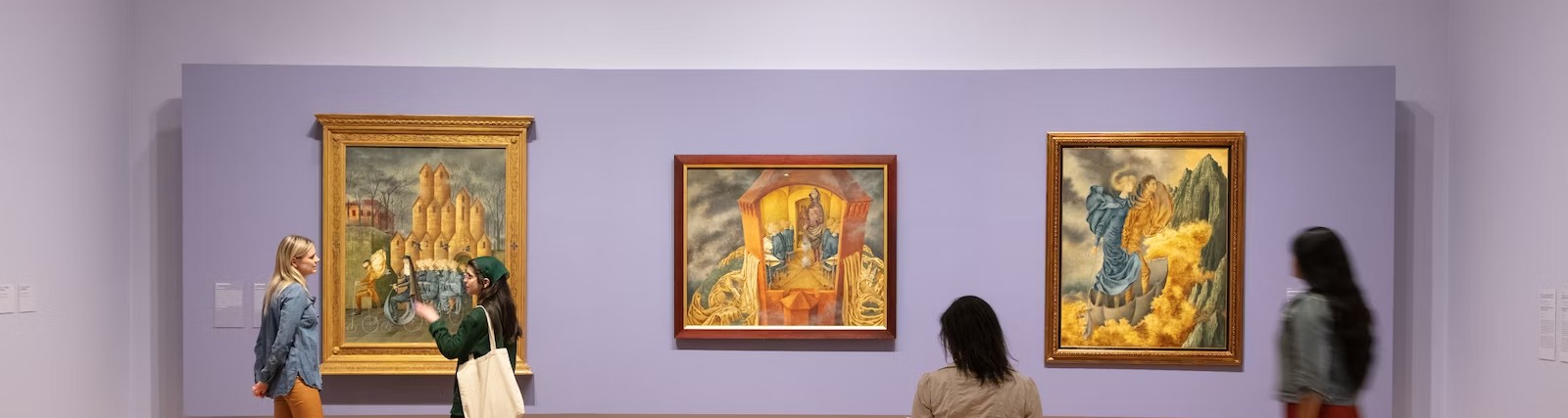
Remedios Varo’s early years combined travel for her father’s engineering work, Catholic schooling in Madrid, and rigorous academic art training at the Real Academia de Bellas Artes de San Fernando. The outline below follows Encyclopaedia Britannica and the National Museum of Women in the Arts.
Birth and family
She was born on 16 December 1908 in Anglès, a town in the province of Girona, Catalonia (Britannica; NMWA). Britannica gives her original name in full as María de los Remedios Alicia Rodriga Varo y Uranga. Her father was a hydraulics engineer who taught her technical drawing when she was young. That training—measured lines, spatial clarity, the habit of copying diagrams—later shows up in the architectural precision of her mature paintings, a connection museum writers often make without needing to invent childhood anecdotes.
His job required frequent travel. Britannica states that the family traveled throughout Spain and North Africa before settling in Madrid in 1917. The old RemediosVaro.com homepage said the family settled when she was eight (about 1916–1917). Those statements are close; this page follows Britannica’s explicit year, 1917.
The Spanish Civil War began in 1936, two decades after the Madrid settlement, so her childhood travels belong to an earlier chapter than wartime exile.
Catholic schooling and rebellion
In Madrid, Britannica says, Varo attended Catholic school and then pursued art at the Royal Academy of Fine Arts of San Fernando. NMWA adds that she was influenced by her engineer father and by strict Catholic schooling “against which she rebelled.”
Religious painting would later become a creative source for her adult work. Art Institute curators note that she made an Icono (Icon) in the 1940s with gold leaf and mother-of-pearl, and that a late triptych of 1960–1961 borrows the color and three-part structure of a winged altarpiece. Those adult works are discussed on the themes and major-works pages; they are mentioned here only to show that Catholic visual culture remained a resource even after she rejected institutional strictness.
The Real Academia de Bellas Artes de San Fernando
San Fernando was (and is) a prestigious Madrid academy with a demanding, traditional curriculum. Britannica records that Varo graduated in 1930 with a degree qualifying her to teach drawing. MoMA’s artist note similarly places her training as a painter after observational drawing lessons from her father, then liberation from academic expectations when she moved to Barcelona and Paris in the 1930s.
Graduation in 1930 places her among the minority of women who completed that academic path in the period. Secondary biographies often discuss early marriages and moves after graduation; Britannica’s short entry skips those personal details and jumps to mid-1930s Barcelona Surrealism.
Madrid’s museums as a classroom
Britannica later names Hiëronymus Bosch as an admired influence whose mysterious compositions shaped her sensibility. Students at San Fernando had access to Madrid’s great collections, and Bosch’s presence in the Prado is a standard point in accounts of her early visual education.
From Madrid toward the avant-garde
After 1930, the next firmly dated chapter in Britannica is mid-1930s Barcelona: involvement with Surrealism and the Logicophobista group, then the 1936 meeting with Benjamin Péret. Those years are covered on the Paris and Surrealism page. For early life the outline is simple: Anglès 1908, travel, Madrid 1917, Catholic school, San Fernando, graduation 1930 with a teaching credential in drawing.
Draftsmanship as lifelong habit
MoMA’s artist note begins with observational drawing learned from her father before academic painting training. Britannica’s emphasis on technical drawing in childhood and expert draftsmanship in later architectural passages tells the same story from two institutions. When Art Institute conservators describe cartoons transferred onto scratched gesso panels in the 1950s, they are describing adult studio method—but the patience for measured preparation was rehearsed early.
Women at San Fernando
Completing San Fernando in 1930 with a credential to teach drawing (Britannica) placed Varo in a demanding academic pipeline that few women finished. MoMA frames the later move to Barcelona and Paris as liberation from academic painting and family expectations. NMWA notes that she rebelled against strict Catholic schooling—rigorous training, then deliberate departure.
Connecting early life to later themes
Art Institute essays on religion as a creative source (devotional icons, altarpiece formats, a Mother Superior in Hacia la torre) make more sense once Catholic schooling is on the record. Likewise, alchemy and engineering metaphors in mature paintings sit more clearly beside a hydraulics-engineer father who taught her to draw. The connections are interpretive frames offered by museums; they are not proof that each painting secretly encodes a childhood diary.
Continue to Biography for the full arc, or to Paris and Surrealism for the 1930s leap into avant-garde life.
Sources
- Encyclopaedia Britannica, Remedios Varo
- National Museum of Women in the Arts, Remedios Varo
- Art Institute of Chicago, The Dueling Dualities of Remedios Varo
- MoMA, Remedios Varo artist page
- Art Institute of Chicago, Remedios Varo: Science Fictions