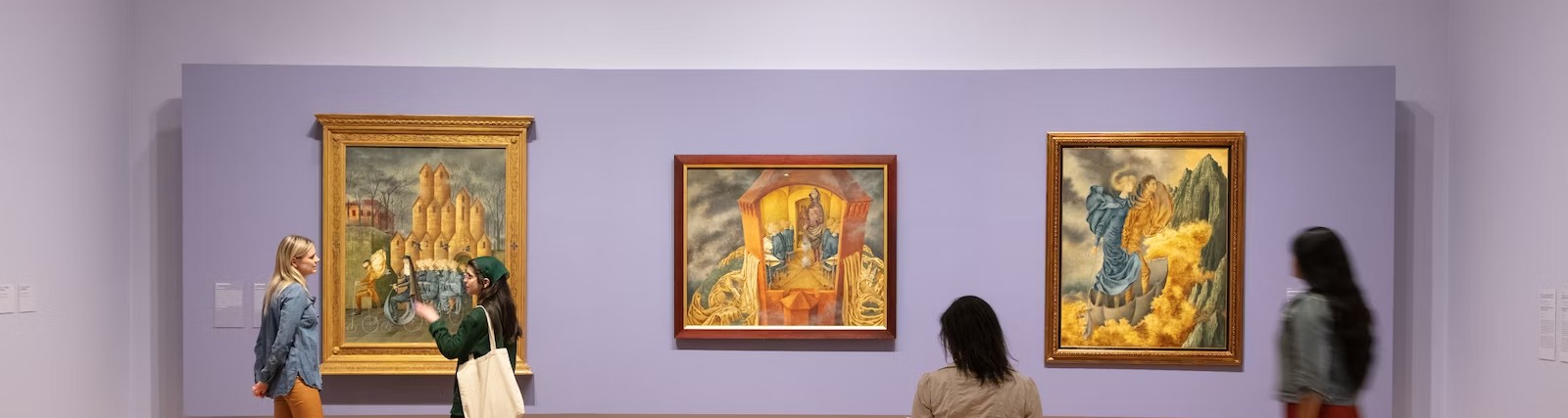
Varo’s Surrealist years run from Barcelona’s mid-1930s avant-garde through Paris exhibitions and the scramble to leave occupied France. The chronology below follows Encyclopaedia Britannica, NMWA, and MoMA.
Barcelona and Logicophobista
Britannica states that in the mid-1930s, while living in Barcelona, Varo began to involve herself in Surrealism and joined the avant-garde artists’ group Logicophobista. Barcelona in those years was a liberal artistic center relative to much of Spain, and Britannica records her membership in Logicophobista.
In 1936 she met Surrealist poet Benjamin Péret (Britannica). That year also saw the outbreak of the Spanish Civil War—the political backdrop for their departure.
Marriage, Paris, and Surrealist activity
Britannica records that Varo and Péret fled Spain for Paris and married in 1937. They were soon absorbed into Surrealist activities there: she exhibited with the group and published drawings in Surrealist publications. NMWA separately says she moved to Paris in 1937 and associated and exhibited with the Surrealists while exploring magic, alchemy, and analytical psychology.
MoMA emphasizes that moving to Barcelona and Paris in the 1930s offered liberation from academic painting and family expectations, exposing her to modernist thinkers and a close association with Surrealist artists. Evidence of that intimacy includes an untitled 1935 collage created with Esteban Francés, Oscar Domínguez, and Marcel Jean using the cadavre exquis (exquisite corpse) technique—a collaborative game-process central to Surrealist practice. MoMA’s online collection lists that collage among her works.
Through this circle she also knew Leonora Carrington, who later became her closest friend in Mexico (Britannica; NMWA). André Breton was a central organizer of Surrealism; Varo exhibited with the group and published in its journals.
War, arrest, and the impossibility of return
NMWA states that after the Spanish Civil War she found she could not return to Spain. As World War II threatened Paris, Spanish refugees came under threat. Varo was arrested and held in early 1940. After her release, she fled Paris in the face of the Nazi invasion and, by late 1941, secured passage to Mexico.
Britannica places the couple’s flight to Mexico in late 1941 to escape Nazi-occupied France. Accounts differ on detail: Britannica summarizes the destination and year, while NMWA adds the 1940 detention. Neither source publishes the prison location, duration, or conditions on the pages cited here.
What Surrealism gave her—and what she later remade
In Paris she learned group exhibition culture, automatic and chance procedures, and a language of dream imagery. Art Institute writing on her Mexico City maturity argues that she then went “well beyond” European Surrealism, pairing narrative invention with an unusually rich material surface. MoMA’s label for The Juggler (The Magician) (1956) still names decalcomania—a Surrealist favorite—as one of her tools, used in a deliberate, planned way rather than as pure accident (see also the Art Institute’s technique notes).
NMWA’s Magic of Remedios Varo exhibition text later remarked that although Surrealism was the aesthetic within which she developed, her later work creates an alternate vision of the movement. That is a curatorial judgment about the 1950s–60s paintings, not a claim that she rejected Surrealism wholesale in 1937–1941.
Bridge to Mexico
By late 1941 she had left Europe for Mexico City, where commercial work, new friendships, and eventually full-time painting awaited. Continue to Mexico years and Carrington and Horna. For the academic roots behind her draftsmanship, see early life and training.
Exquisite corpse and group practice
MoMA’s collection includes the untitled 1935 collage made with Esteban Francés, Oscar Domínguez, and Marcel Jean using cadavre exquis. That object is concrete evidence of collaborative Surrealist play before the Péret marriage year Britannica records (1937). It also shows she was already inside experimental networks while still tied to Spanish avant-garde circles. Britannica notes that she exhibited with the group and published drawings in Surrealist publications.
Psychology, magic, and alchemy in the Paris years
NMWA states that while associating and exhibiting with Surrealists she explored magic, alchemy, and analytical psychology. Those interests did not wait for Mexico; Mexico intensified them. Art Institute writers later show alchemy books in her library and dream-recipe play with Carrington and Horna—continuities that begin in the Surrealist milieu even when the decisive canvases are Mexican.
Why the arrest matters
NMWA’s early-1940 arrest note records state pressure on Spanish refugees in France before the final escape to Mexico. Late 1941 Mexico was a survival move that became a permanent home; the Art Institute notes that she emigrated permanently to Mexico City.
Sources
- Encyclopaedia Britannica, Remedios Varo
- National Museum of Women in the Arts, Remedios Varo
- NMWA, The Magic of Remedios Varo (2000)
- MoMA, Remedios Varo artist page
- MoMA, The Juggler (The Magician), 1956
- Art Institute of Chicago, The Dueling Dualities of Remedios Varo
- Art Institute of Chicago, Remedios Varo: Science Fictions