Welcome to RemediosVaro.com—a guide to the life and art of Remedios Varo (María de los Remedios Alicia Rodriga Varo y Uranga), the Spanish-born painter who built her mature Surrealist career in Mexico City. Explore her biography, major works, themes and techniques, friendships in exile, museum exhibitions, and a reading list for going further.
Encyclopaedia Britannica records her birth on 16 December 1908 in Anglès, Spain, and her death on 8 October 1963 in Mexico City of a heart attack, at age 54. She trained at the Real Academia de Bellas Artes de San Fernando in Madrid, worked among Surrealists in Barcelona and Paris, fled wartime Europe in 1941, and painted the bulk of her celebrated oils in Mexico in the last decade of her life. The National Museum of Women in the Arts (NMWA) and the Museum of Modern Art (MoMA) agree on those core dates and on her association with Surrealism; the Art Institute of Chicago’s 2023 exhibition Remedios Varo: Science Fictions focused on the Mexico City paintings of 1955–1963.
Why Varo matters
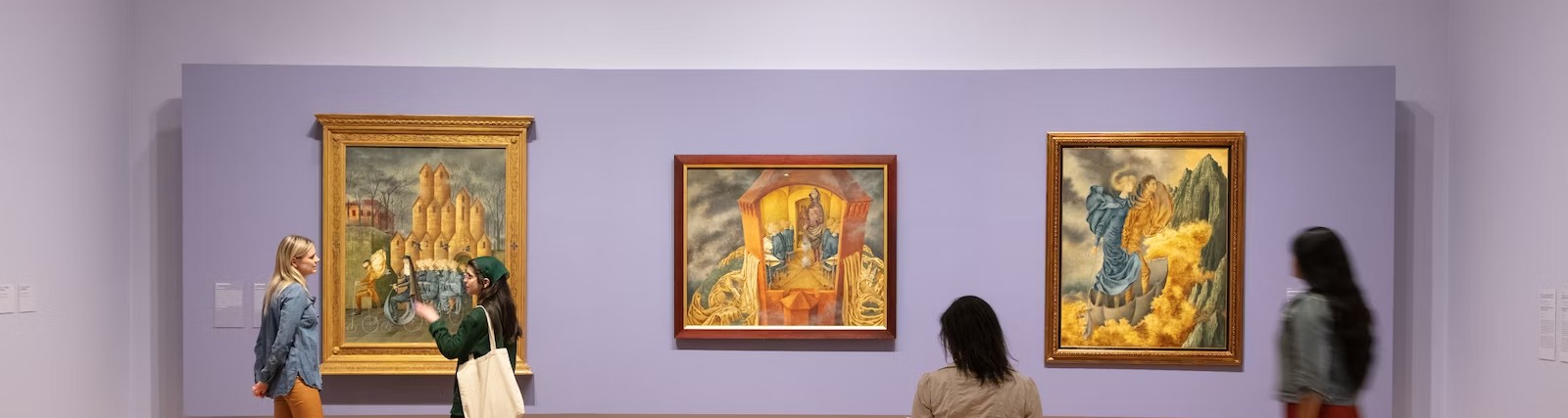
Britannica describes meticulously rendered fantastical paintings that combine science, alchemy, mysticism, psychology, and magic, often with androgynous figures engaged in experiments, journeys, or quests. Art Institute curators stress a dual investment in narrative and material surface: Surrealist chance techniques such as decalcomania sit beside Renaissance-like preparation and jewel-like detail. In Mexico she became a household name; abroad, museum attention arrived more slowly, then accelerated with NMWA’s 2000 retrospective and Chicago’s 2023 show.
MoMA’s artist summary notes that by her death she had created over 500 works, most produced in Mexico, and that she aimed to reveal “hidden metaphysical wonders” through close observation and meticulous technique. Museum collection pages are the best place to view works such as MoMA’s The Juggler (The Magician) (1956) and NMWA’s La llamada (The Call) (1961).
Start with these pages
Biography
From Catalonia to Mexico City: training, Surrealism, exile, and mature fame.
Read the biographyExhibitions
Museo de Arte Moderno, NMWA 2000, Art Institute 2023, MoMA holdings.
Exhibitions and museumsLife in brief
Her father, a hydraulics engineer, taught her technical drawing. The family traveled in Spain and North Africa before settling in Madrid in 1917 (Britannica). She graduated from San Fernando in 1930 with a qualification to teach drawing. In mid-1930s Barcelona she joined the Logicophobista circle; in 1936 she met Surrealist poet Benjamin Péret; they married in 1937 and worked among Paris Surrealists. NMWA records that she was arrested and held in early 1940 as Spanish refugees came under pressure, then fled Paris and reached Mexico by late 1941.
In Mexico City she worked in commercial art, design, and related crafts before turning fully to personal painting in the early 1950s with support from Austrian businessman Walter Gruen (Britannica: full devotion to painting from 1953; first solo exhibition 1956, with crowds and waiting lists). She died in 1963 at the height of local renown. Separate pages expand early life, Paris, Mexico, and her friendship with Leonora Carrington and Kati Horna.
Art, themes, and technique
Recurring subjects include alchemists, musicians who move matter, seekers in improbable vessels, and towers that feel both medieval and modern. Art Institute essays document her library interests (including alchemy and astrophysics texts) and her deliberate use of cartoons, decalcomania, grattage, soufflage, textured gesso, and mother-of-pearl inlay. Read themes and symbols and techniques for that material in plain language.
Seeing the paintings
MoMA publishes The Juggler (The Magician) (1956) with medium, dimensions, credit line, and a gallery label explaining preparatory transfer, scratched gesso, and decalcomania. NMWA publishes La llamada (The Call) (1961) with a full interpretive note on quest imagery, alchemical tools, and palette. Art Institute pages for the closed 2023 exhibition still document more than twenty Mexico-period paintings plus archive materials and name partner Museo de Arte Moderno. Those museum pages are excellent places to look closely at the works discussed here.
How the site is organized
Life pages (early life, Paris, Mexico, Carrington and Horna) follow her chronology. Art pages (major works, themes, techniques, Varo and Dalí) take up how the paintings look and what they explore. Exhibitions and legacy cover museums and later reputation. The reading list names catalogues and books for going deeper.
A landmark Chicago exhibition
In 2023 the Art Institute of Chicago presented Remedios Varo: Science Fictions (29 July–27 November 2023), a major survey of her Mexico City paintings from 1955 to 1963. The show is now closed; the museum’s exhibition page remains a useful public record of what was on view and how curators framed her work.
Browse by topic
- Early life and training in Spain
- Paris and Surrealism
- Themes and symbols · Techniques
- Leonora Carrington and Kati Horna
- Varo and Salvador Dalí (rewritten from the old comparison page)
- Legacy · Reading list
RemediosVaro.com is not a museum, gallery, or rights holder.
Sources
- Encyclopaedia Britannica, Remedios Varo
- National Museum of Women in the Arts, Remedios Varo
- Art Institute of Chicago, Remedios Varo: Science Fictions
- MoMA, Remedios Varo artist page
- MoMA, The Juggler (The Magician), 1956
- NMWA, La llamada (The Call)